
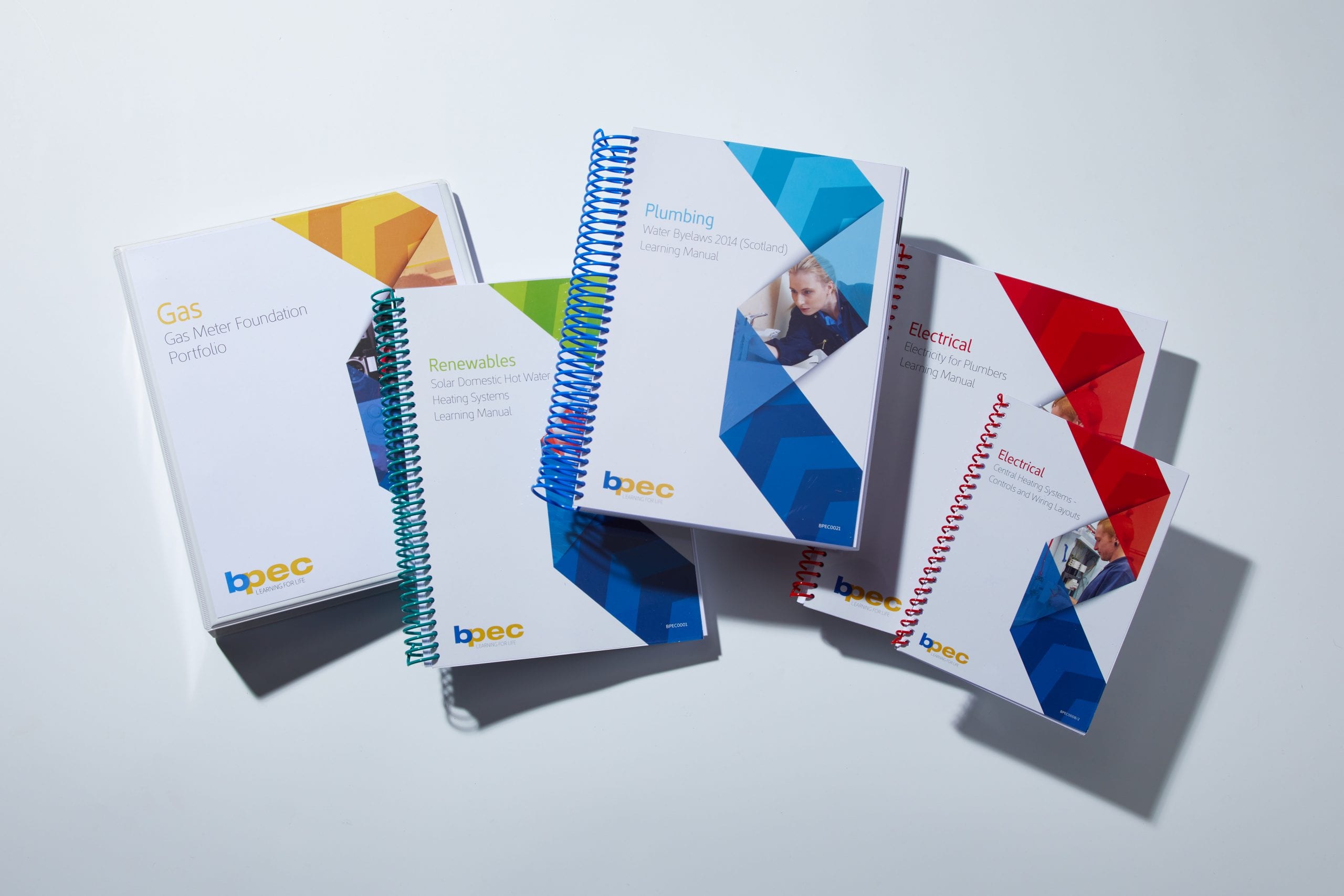
Training workbook printing is the production of the manuals, workbooks and handouts your learners use on a course, from a single module to a full qualification. The format you choose, meaning the paper, the binding and how many you print, decides whether those workbooks are still in one piece and still accurate by the last session.
Think of a delegate on day three of a course, trying to fill in a worksheet as the workbook keeps snapping shut on their pen. Or a trainer telling the room to ignore page 14 because the rules changed last month. Both are format problems, and both are easy to avoid at the briefing stage. At Birch, we’ve been producing training manuals for a wide range of educational organisations for many years, so here’s what to decide before your next run of training workbook printing in the UK.
What paper should a training workbook be printed on?
A training workbook works best on an uncoated paper of around 100 to 120gsm for the inside pages, with a heavier cover to take the knocks. That sounds like a small detail, but it’s the one learners notice first.
Uncoated paper takes pen and pencil cleanly, so notes and answers don’t smudge. Silk and gloss stocks look smart, but some pens smear on them and the shine can catch the glare from classroom lights. Go much lighter than 100gsm and writing can show through when both sides of the page are used. For the cover, a heavier board of around 250 to 350gsm, or a laminated cover, copes far better with being thrown in a bag every day. Laminated covers are worth a look for workshop or site-based courses, where hands are rarely clean. Our guide to paper weights and stocks explains gsm and coated versus uncoated in more detail.
Which binding is best for training manuals?
The best binding for a training manual is usually one that lets it lie flat, because learners need both hands free to write. There’s no single right answer, and each option suits a different kind of course:
- Wire binding (wiro). The manual lies flat and folds right back on itself, which makes it a favourite for workbooks people write in. It takes almost any page count. The trade-off is that there’s no printed spine, so manuals are harder to spot on a shelf.
- Ring binders. Pages come out and go back in, so when one module changes you reprint a few pages instead of the whole manual. That suits qualifications that update often. Binders cost more per copy and take up more room in a bag.
- Perfect binding. A glued spine, like a paperback, looks polished and can carry a printed spine. It’s a good fit for student handbooks and reference guides, but it won’t stay open on a desk, and it needs enough pages to form a spine.
- Saddle stitching. Staples through the fold make this the quickest and lowest-cost option for short handouts. Page counts run in multiples of four, and it usually tops out somewhere around 48 to 64 pages, depending on the paper.
If you’re torn between two options, think about how the manual gets used. Written in every session points to wire or rings. Read and kept for reference points to perfect binding. A quick handout points to saddle stitching.
How many training manuals should you print?
The right number of training manuals covers a realistic stretch of courses, not a whole year in one go. Big runs bring the unit price down, so they’re tempting, but the saving disappears the moment a course changes and boxes of out-of-date manuals go to recycling.
BPEC, who provide qualifications in plumbing, renewable energy, gas and electrical training, had exactly this problem. Popular and niche courses were stocked in equal quantities to keep the price even, so stock sat for months and course changes meant scrapping good manuals. We refreshed the artwork across their whole range, priced it on total manual usage instead of title by title, set a monthly stock level for each manual and added a 48-hour turnaround for exceptional orders. You can read the full BPEC case study on our site.

How do you keep course manuals up to date?
Course manuals stay up to date when the artwork is treated as a living file and runs are small enough to change. A little planning here saves a lot of awkward moments in the classroom.
- Put a version number and date on every page footer or the back cover, so trainers can see at a glance which edition they’re holding.
- Keep one master artwork file, held by your design team or your printer, so updates always start from the latest version.
- Use ring binders for the modules that change most, and fixed binding for content that stays stable.
- Check stock levels whenever an awarding body or regulator announces changes, before the next print run goes ahead.
Our design for print team handles layout, typography and artwork prep, so an updated module can go back to print-ready without starting from scratch.
Can you outsource training material printing?
Yes, you can outsource training material printing completely, from artwork through to storage and final delivery. For a lot of learning and development teams, that’s the part that frees up the most time.
With our print management service, we look after proofing, production, warehousing and dispatch, with one dedicated contact for your account. Your manuals are stored at our 27,000 sq ft warehouse in Derbyshire, then picked, packed and sent out when a course needs them through our print fulfilment and delivery service. If your manuals sit alongside event packs and marketing print, our guide to managing print, stock and fulfilment in one place shows how it all fits together.
If a new run of workbooks is on the horizon, have a look at our training manuals page, or get in touch. We’ll talk through your course, your learners and how many you really need. You can also call us on 0115 951 2468 or email team@birchprint.co.uk.