

Wayfinding signage is the set of signs that guides people through a building or site, from the front door to the place they need to be. Good wayfinding covers directional signs, location signs and information points, all designed to look and read the same way so visitors can follow them without stopping to think.
You’ll know it when it’s missing. Think of the last time you walked into a hospital, a business park or an office block and spent five minutes hunting for reception. At Birch, we help marketing and facilities teams make sure their visitors never have that experience.
What does wayfinding signage include?
Wayfinding signage includes four main types of sign, each with its own job:
- Directional signs, which point people towards places, such as “Reception” with an arrow
- Identification signs, which tell people they’ve arrived, such as a meeting room name on the door
- Information signs, such as site maps, opening hours and floor guides
- Safety and regulatory signs, such as fire exits and restricted areas
You don’t need every type in every building. A small office might only need a clear entrance sign, a few arrows and door signs. A warehouse or campus needs the full set.
Why does wayfinding signage matter for your brand?
Wayfinding signage matters for your brand because it’s often the first thing a visitor experiences after your website. People pick up the colours, words and shapes of the signs around them, and that shapes how they feel about the business before they’ve met anyone.
Clear signs also save your team time. Every visitor who finds their own way is one less person stopping a colleague or ringing reception to ask where to go.
Where should wayfinding signs go?
Wayfinding signs should go at every point where someone has to make a decision. That means entrances, car parks, lift lobbies, corridor junctions and the top and bottom of stairs.
The easiest way to plan this is to walk the route yourself as if you’ve never been there before. Start at the car park or the street, and every time you pause to wonder which way to go, that’s where a sign belongs. Then walk it again from the other direction, because people have to find their way out too.
How big should wayfinding signs be?
Think about where people will be standing when they need the sign, because that decides how big it should be. A door sign can be small because people read it up close, but a directional sign at the end of a long corridor or across a warehouse floor needs much larger lettering.
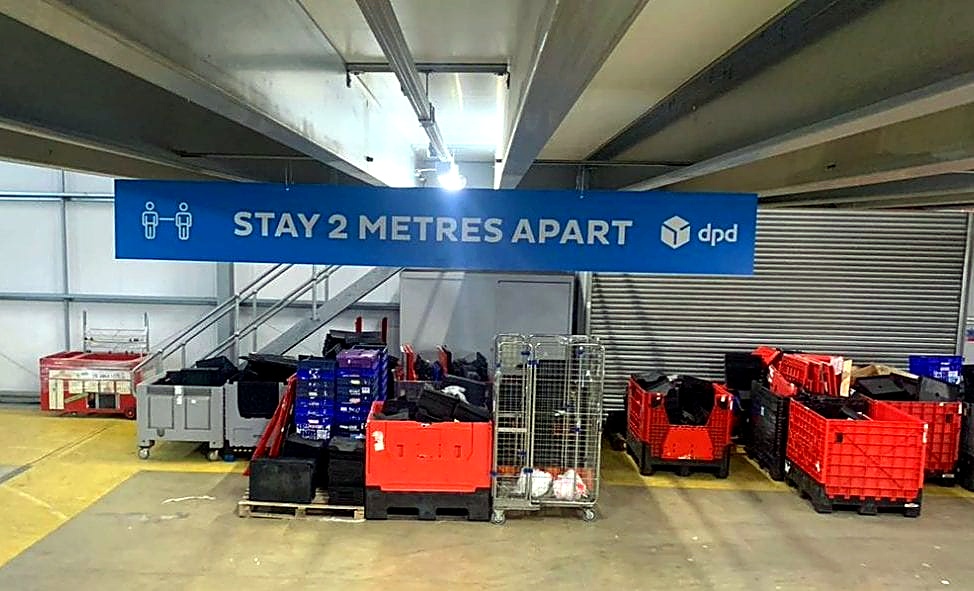
Height matters as much as size. When DPD needed signage across the 27 acre sortation hub at its Oldbury site, we produced 2.4 metre wide double-sided hanging signs, hung low enough to be noticed but high enough to stay clear of forklift trucks. You can read how that came together in our large scale signage case study.
What makes wayfinding signage easy to read?
If people have to squint at a sign, it isn’t doing its job. The good news is that easy-to-read wayfinding signage comes down to short words, strong contrast and a consistent layout. A few simple rules go a long way:
- Keep the wording short, ideally one or two words plus an arrow
- Use dark text on a light background or light on dark, never similar shades together
- Choose a clear, simple typeface rather than a decorative one
- Use the same names on the signs as you use in emails and visitor instructions
- Put arrows in the same position on every sign
If your building has specific accessibility requirements, it’s worth checking them with whoever manages the building before signs go into production. Our design for print team can set the artwork up so every sign follows the same rules.
What materials are used for wayfinding signs?
Wayfinding signs can be printed on a wide range of materials, and the right one depends on where the sign lives and how long it needs to last. At Birch, we print signage for offices, events and exhibitions, including:
- Wall signs and back-lit signs for receptions and entrances
- Hanging boards for warehouses and large open spaces
- Floor vinyl for marking routes and walkways
- Pavement swing signs and feather flags for outdoor spaces
- Roller banners and display stands for temporary routes at events
For the DPD project, we used 10mm Stadur board because it’s lighter than foamex or dibond without losing image quality, which made it easier to hang from girders. Fully recyclable options are available for larger displays too, which helps if you’re working to a sustainability brief.
How do you brief wayfinding signage?
Briefing wayfinding signage is easier than it sounds, and you don’t need to be a signage expert to do it. Pull together:
- A floor plan or site map, even a rough one
- A list of the places people need to find
- Photos of the spaces where signs will go
- Your brand guidelines or logo files
- Any deadline, such as an opening date or an event
That’s enough for us to suggest the right sizes, materials and positions, and to give you a realistic price. If you’re not sure what you need, that’s fine. Talking it through is part of the job.
Can wayfinding signage be temporary?
Yes, and temporary wayfinding signage is often the most useful kind. Events, open days, building works and seasonal pop-ups all need signs that go up quickly and come down cleanly.
Roller banners, floor vinyl and freestanding boards are popular for short-term routes. Our banners, signs and displays page shows the full range.
Ready to help your visitors find their way?
Not sure where to start with your signage? Get in touch, send us a photo of the space, and we’ll suggest what would work, whether that’s a handful of door signs or a full site.


